

Scientific Presentation
Spray Dried Amorphous Epinephrine Nasal Powder for the Acute Treatment of Anaphylaxis
Introduction
Considering that most epinephrine products are designed for acute use, a prolonged shelf-life and enhanced overall stability is desirable. This is critical, especially considering the significant time gap that may exist between when a product is acquired by the patient or medical staff and when it is used. Existing products, such as EpiPen®, have narrow temperature storage conditions (20° to 25°C) and an expiration date of no more than two years [1]. Moreover, patients frequently subject these products to conditions beyond the recommended storage parameters, such as temperature fluctuations ranging from 15°C to 30°C, which can further compromise their integrity. Patients also require sufficient training to effectively administer the accurate dose at the right site using the injection pen. Many patients perceive this invasive therapy, which involves needle insertion, as unpleasant [2-3].
Intranasal administration is an alternative route of drug delivery that may offer several advantages, including that the peripheral blood vessels in the nasal cavity can facilitate swift absorption of the drug. In addition, some non-invasive devices now available, allow the patient or caregiver to deliver a dose of drug easily without the need for an inspiratory airflow.
We have developed a rapidly dissolving, spray-dried, nasal powder formulation that addresses the stability challenges of liquid forms while preserving the advantages of nasal administration. This was done by incorporating epinephrine into our novel drug delivery platform, amorphOX® (Orexo, Sweden), which consist of a powder composed of amorphous particles optimized for nasal deposition.
Going from this…
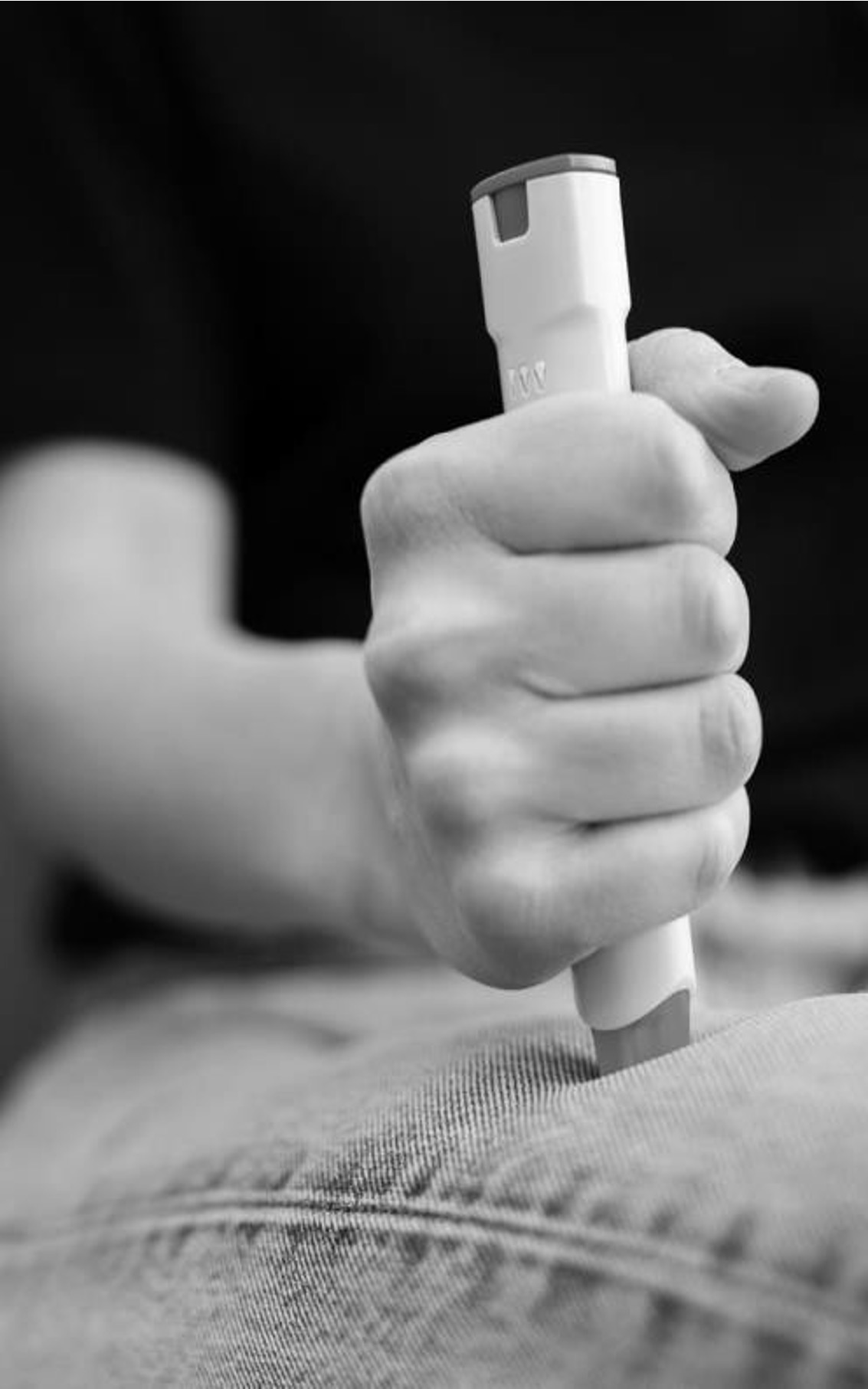
Epinephrine is light sensitive and should be stored in the carrier tube provided. Store at 20° to 25°C (68° to 77°F); excursions permitted to 15°C-30°C (59°F-86°F) (See USP Controlled Room Temperature). Do not refrigerate.
Protect from light. Before using, check to make sure the solution in the auto-injector is not discolored. Replace the auto-injector if the solution is discolored or contains a precipitate.[1]
...to this

Methods
Four nasal epinephrine powder formulations (OX640-1, 2, 3 and 4, Table 1.) containing epinephrine bitartrate (corresponding to a 1 mg dose of epinephrine base), a trehalose and maltodextrin combination (carrier material) and sucrose laurate (permeation aid) were manufactured using a laboratory spray dryer (PROCEPT, Belgium).
The obtained powders were then filled Unidose (UDS) powder dose spray system devices (Aptar Pharma, France) to a fill weight of 25 mg and placed in protective storage tubes including desiccant.
The products were analyzed for particle size using laser diffraction (Mastersizer 3000, Malvern) and aerodynamic characteristics using the Next Generation Impactor (NGI, aPSD), glass transition temperature (Tg) using Differential scanning Calorimetry (DSC and crystallinity using x-ray powder diffraction (XRPD).
Stability was compared to the commercially available EpiPen and monitored for 12 months at 40°C and 75% relative humidity (40°C/75% RH), corresponding to accelerated conditions[4] and analyzed using high-performance liquid chromatography.
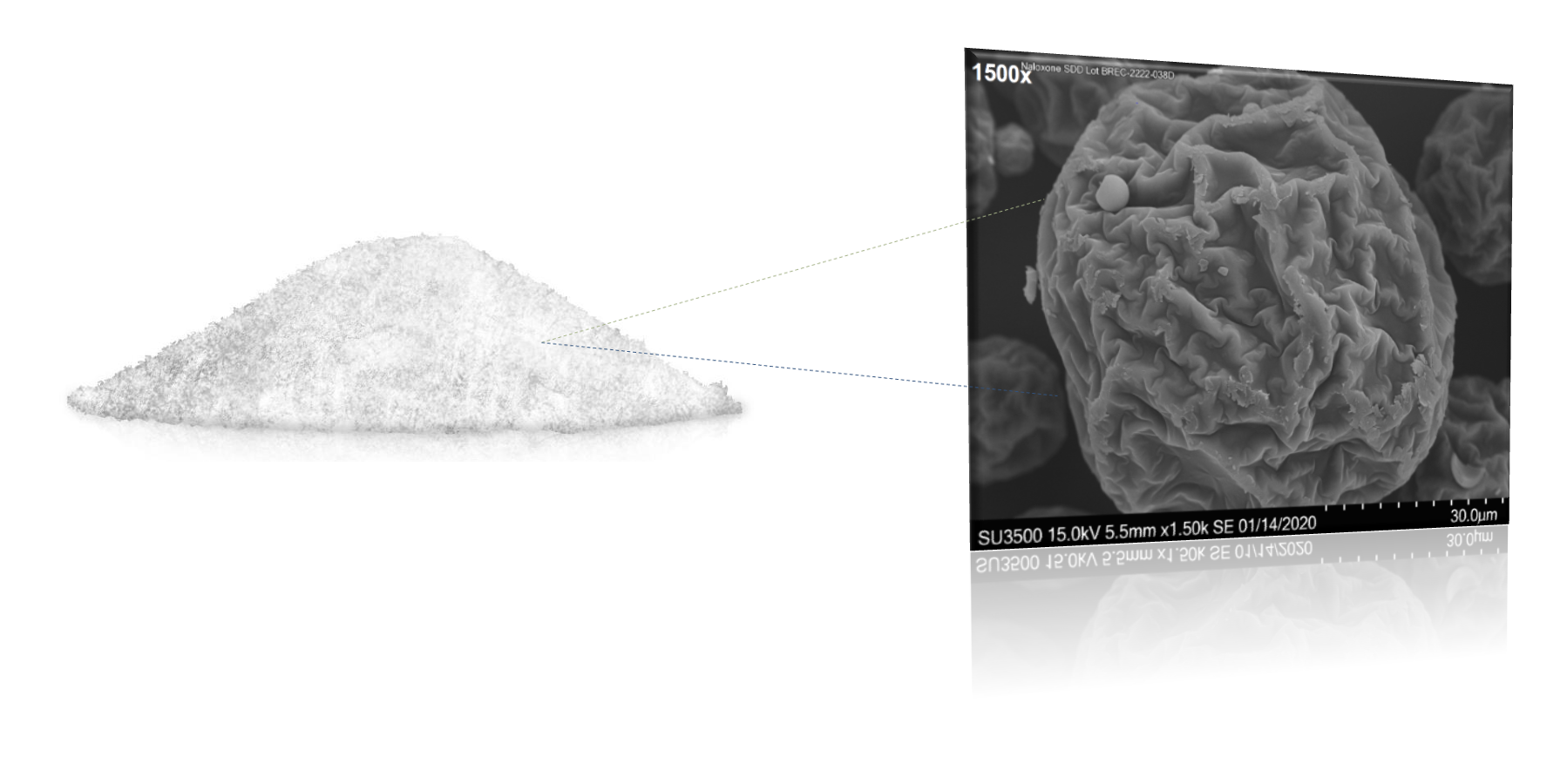
Table 1: Composition of test formulations OX640-1 to 4
| Component | OX640-1 (w/w%) | OX640-2 (w/w%) | OX640-3 (w/w%) | OX640-4 (w/w%) |
|---|---|---|---|---|
| Epinephrine bitartrate (corresponding to 1 mg epinephrine base) | 7.28 | 7.28 | 7.28 | 7.28 |
| Trehalose (carrier material, chemical stabilizer) | 20 | 40 | 56 | 75 |
| Maltodextrin (carrier material, physical stabilizer) | 65.72 | 45.72 | 29.72 | 10.72 |
| Sucrose laurate (permeation aid) | 3 | 3 | 3 | 3 |
| Residual water | 4 | 4 | 4 | 4 |
Results and discussion
The spray-drying yielded free flowing powders with a narrow particle size distribution and a low degree of fine particles and were thus suitable for effective nasal deposition with minimal risk for deposition in the lungs.5 The recovery of the process was between 71-75%. Stability was similar for the two compositions, with almost no degradation detected after 1 year storage in accelerated conditions (Table 2).
Table 2: Powder characteristics at release (T0) and stability after 12 months (T12) at long term and accelerated conditions
| Composition | Dv10, Dv50, Dv90 T0 | Dv10, Dv50, Dv90 T12 | FPF <5µm T0 (%) | FPF <5µm T12 (%) | XRPD T0 and T12 | Tg (°C) 11%, 33% RH |
|---|---|---|---|---|---|---|
| OX640-1 | 14, 30, 55 | 14, 29, 55 | 0.4 | 0.4 | amorphous | 66, 58 |
| OX640-2 | 14, 30, 56 | 14, 30, 55 | 0.4 | 0.3 | amorphous | 65, 54 |
| OX640-3 | 15, 31, 57 | 15, 31, 56 | 0.2 | 0.2 | amorphous | 65, 51 |
| OX640-4 | 15, 30, 54 | 15, 30, 53 | 0.2 | 0.1 | amorphous | 64, 43 |
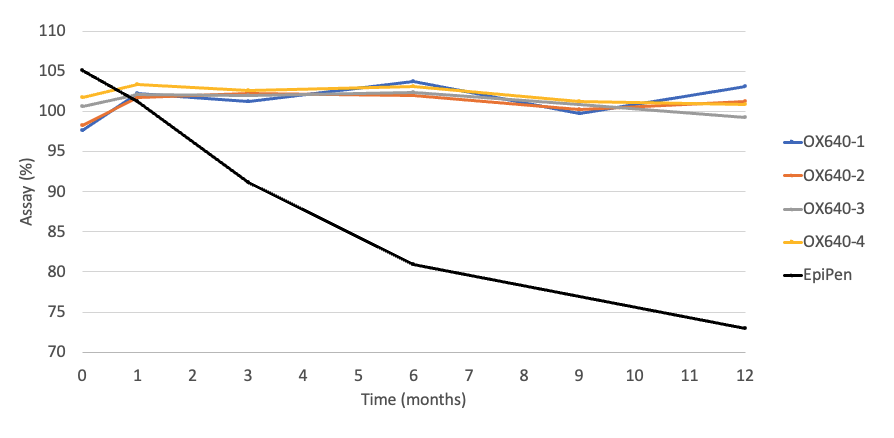
Measuring assay, Figure 1, full dose of epinephrine remained in the powders throughout the study whereas only about 70 % was left in EpiPen.
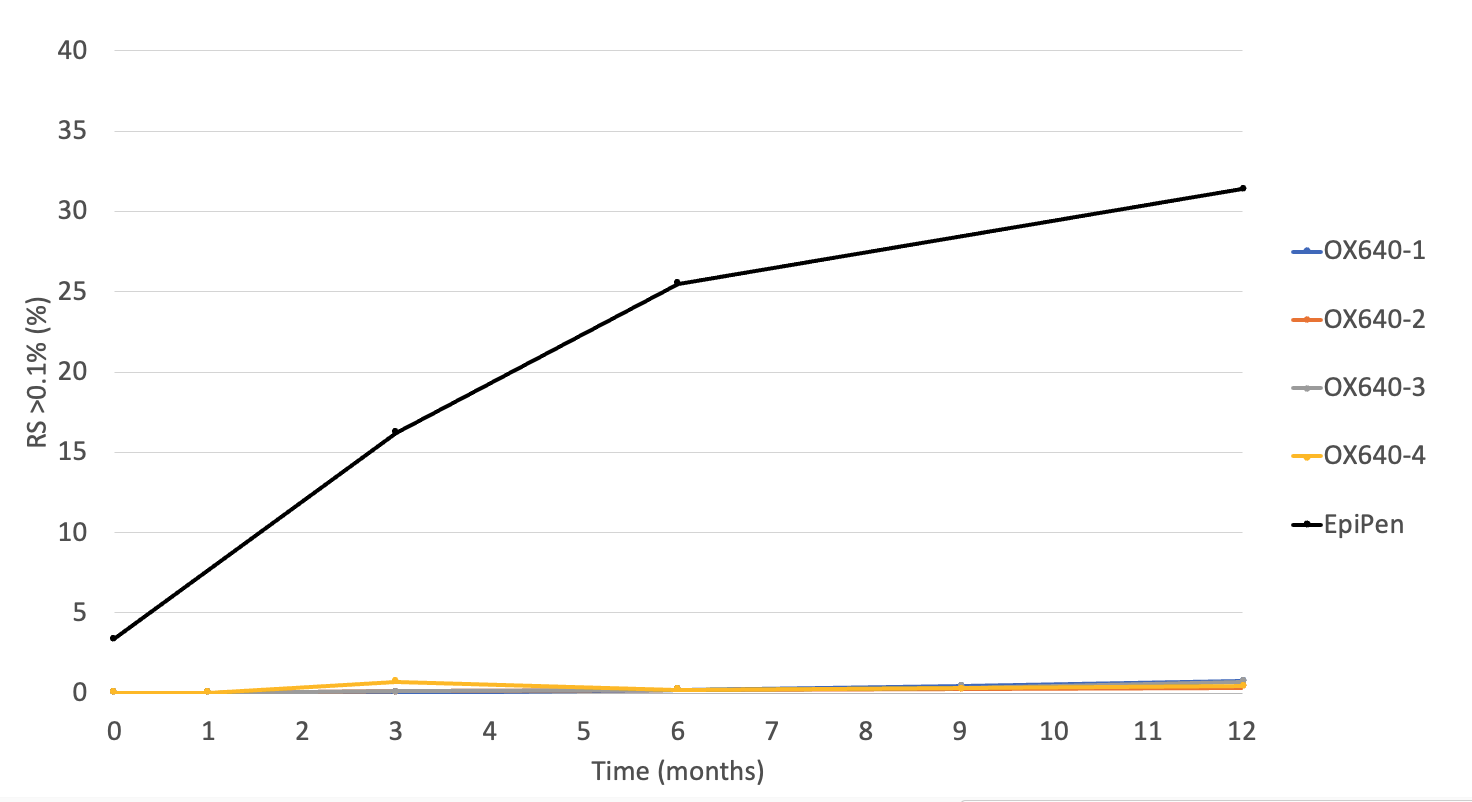
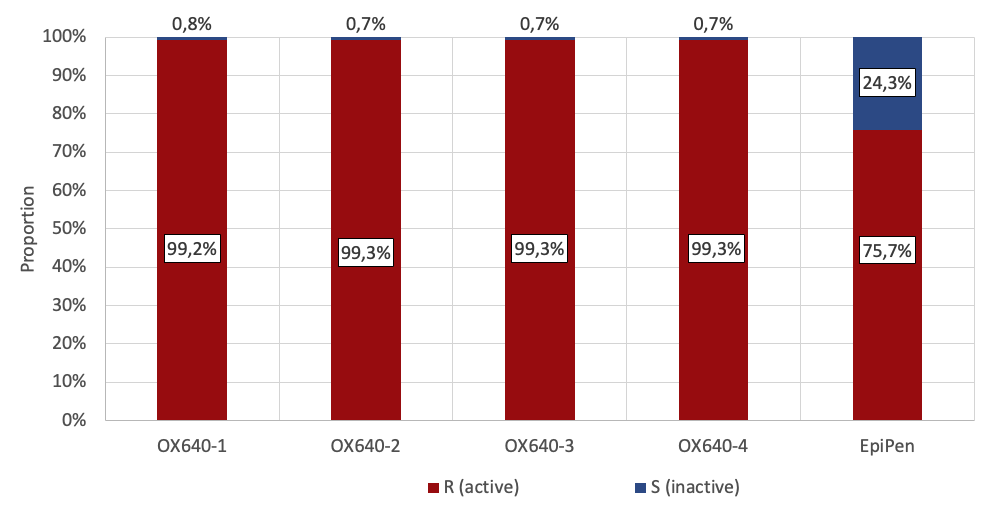
The same trend was confirmed when analyzing related substance (Figure 2), with non of the powders having a total degradation above 1% and EpiPen measuring around 30% total degradation despite being stabilized with both chelating agents and anti oxidants. In addition, the enantiomeric proportions (Figure 3) did not change for the powders, but a clear racemization (24%) was observed for the liquid product. As R-epinephrine is the only active enantiomer the actual potency of EpiPen at the end of the study was only about 55% whereas the powders retained full potency.
Conclusions
-
The spray drying process resulted in an amorphous powder suitable for nasal delivery
-
Compared to the commercially available EpiPen®, all formulations exhibited superior stability under accelerated storage conditions
-
These findings support the feasibility and further development of this nasal powder as a remarkably stable, non-invasive, preservative-free alternative therapy for anaphylaxis
-
This work also demonstrates the potential of our powder-based amorphOX® technology as a platform even for extremely unstable APIs
-
These formulations have been studied in humans, showing comparable PK and PD response to EpiPen. This data was presented at the AAAAI annual meeting 2024, https://doi.org/10.1016/j.jaci.2023.11.877
References
- Mylan: Epipen Prescribing Information [https://www.epipen.com/-/media/files/epipen/prescribing%20information.pdf] Accessed February 15, 2024.
- Prince BT, Mikhail I, Stukus DR.: Underuse of epinephrine for the treatment of anaphylaxis: missed opportunities. J Asthma Allergy 2018;11:143-51.
- Warren CM, Zaslavsky JM, Kan K, Spergel JM, Gupta RS. Epinephrine autoinjector carriage and use practices among US children, adolescents, and adults. Ann Allergy Asthma Immunol 2018;121:479-89.e2.
- ICH Harmonised Tripartite Guideline (2003). Stability testing of new drug substances and products Q1A(R2). ICH Guidelines, ICH Q1A (R2)
- Henriques, P., Fortuna, A., & Doktorovová, S. (2022). Spray dried powders for nasal delivery: Process and formulation considerations. European Journal of Pharmaceutics and Biopharmaceutics.

Jonas Sävmarker
PhD Scientific Director R&D
jonas.savmarker@orexo.com
+46 (0) 70 537 75 77

Robert Rönn
PhD, Senior Vice President Head of R&D
robert.ronn@orexo.com
+46 (0) 18 780 88 00
Meet Orexo at the following scientific conferences
Dec. 9-11 Drug Delivery to the Lungs Conference 2026, Edinburgh, Scotland
Nov. 12-16, 2026 ACAAI, American College of Allergy, Asthma & Immunology's Annual Scientific Meeting, Phoenix, Arizona
Nov. 9-11, 2026 Bio-Europe 2026, Cologne, Germany
Oct. 29-30, 2026 PODD 2026, Boston, MA
Conference link
Oct. 19 -21, 2026 World vaccine conference 2026, Amsterdam, Netherlands
Sep. 16 -17, 2026 IPAC-RS 2026 Nasal Innovation Forum

